When the Brook Dries Up
A Prayer Devotional: Author Richard Matundura, edited by Claire Carter
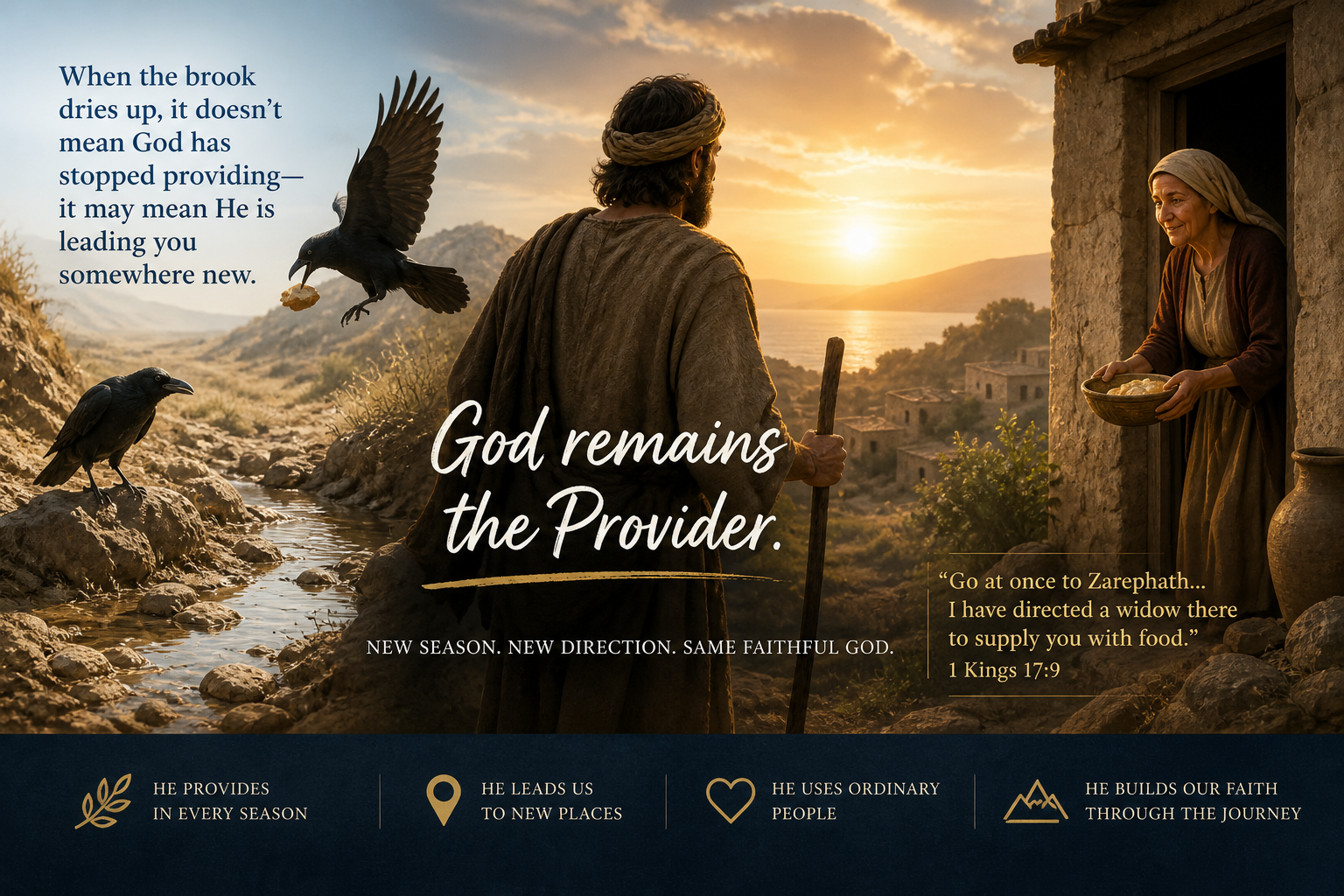
1 Kings 17: 4, 9
“You will drink from the brook, and I have directed the ravens to supply you with food there… Go at once to Zarephath… I have directed a widow there to supply you with food.”
There is a pattern in the way God shapes His people—one that often surprises us. When God intends to make a man or woman useful for His purposes, He does not begin with elevation, but with formation. And more often than we would like, that formation involves breaking before building.
This breaking is not cruel or careless. It is intentional. God, like a skilled craftsman, reshapes what is already there, removing what cannot remain and forming something stronger, deeper, and more dependent on Him. Yet while we may understand this in theory, it is far harder to embrace when we are living through it.
The story of Elijah in 1 Kings 17 gives us a window into this process. God first provides for Elijah in a miraculous but steady way: a brook for water and ravens bringing food. It is an unusual provision, but it is consistent. Elijah knows where the next meal is coming from. He knows where to return each day. There is a rhythm to God’s care.
But then, the brook dries up.
This is a crucial moment. The drying brook is not a sign that God has failed, nor that Elijah has done something wrong. It is simply that the season has changed. The provision that was right for one moment is no longer how God chooses to provide in the next.
So God speaks again: “Go at once to Zarephath… I have directed a widow there to supply you with food.”
This new provision seems even more uncertain than the first. Ravens were miraculous—but a widow in the midst of famine? Someone with almost nothing left? Yet this is where God sends him.
The lesson is clear: the method may change, but the source does not. God remains the provider.
This truth becomes deeply real in our own moments of crisis. There are times when we plan carefully, step forward in faith, and believe everything is in place—only for it all to unravel. Support we counted on disappears. Resources fail. Doors close without warning.
One testimony from my own life reflects this vividly. A conference had been prepared, women had gathered with expectation, and support had been promised. Then suddenly, everything collapsed. Financial systems failed, funds became inaccessible, and what had been carefully arranged could no longer be delivered.
In that moment, the temptation was to withdraw—to shut down, to go silent, to give up.
But instead, a different realisation emerged: this is the moment to discover whether we truly depend on God.
God proved faithful.
Provision came—not always through expected channels, not always in ways that could be easily explained, but in ways that sustained what needed to continue. What began as a moment of breaking became a place of deeper trust.
Others have echoed the same experience. Serving faithfully without clear funding. Supporting others while carrying personal needs. Watching resources fall short again and again—and yet, somehow, continuing. Stories of provision arriving at just the right moment, sometimes in ways that cannot be traced or predicted.
These are modern-day reminders of the same truth Elijah learned: when the brook dries up, God is not finished.
In fact, it is often in these very moments that God is doing His most significant work—not just providing externally, but shaping something internally. He is teaching us to rely less on systems, structures, or certainty, and more on His voice.
Because ultimately, the key to Elijah’s journey was not the brook or the widow—it was his responsiveness to God’s direction.
When the brook dried up, Elijah did not stay where he was, trying to force provision from a place God had moved on from. He listened, and he obeyed. He went where God sent him, even when it didn’t make immediate sense.
That same invitation stands before us.
When what once sustained us is no longer there, will we cling to the past, or will we listen for God’s next instruction? When provision becomes uncertain, will we turn inward in fear, or upward in trust?
God’s provision is not limited. But it is often progressive. He leads us step by step, teaching us to trust Him not just for what we need, but for where we need to go.
And sometimes, the place He leads us to will stretch us even more than the place we left.
Reflection
- Where has the “brook” in your life begun to dry up? Are you being invited to move, to trust, or to listen in a new way? What might it look like to follow God’s direction, even if it feels uncertain?
Prayer
Lord, when familiar sources of provision begin to fail, help me not to lose heart. Teach me to trust You as my true source in every season. Give me ears to hear Your voice and courage to follow where You lead. When I feel uncertain or stretched, remind me that You are faithful, and that Your provision is always enough. Amen.