Why Research Matters: Two Groundbreaking African Studies Strengthening Recovery Ministry
At ISAAC International, we often celebrate the everyday faithfulness of those serving people affected by addiction. Across Africa and around the world, our members walk alongside individuals and families facing substance use, gambling harms, trauma, poverty and social exclusion. Much of this work happens quietly, without headlines or recognition.
Occasionally, however, faithful ministry is accompanied by rigorous academic research that has the potential to influence not only individual lives, but also national policy, professional practice and funding decisions.
This past year has seen two significant studies emerge from Africa, both led by long-standing ISAAC members. While addressing very different issues, together they demonstrate why research matters so much for Christian recovery ministry.
Understanding Gambling and Irregular Migration
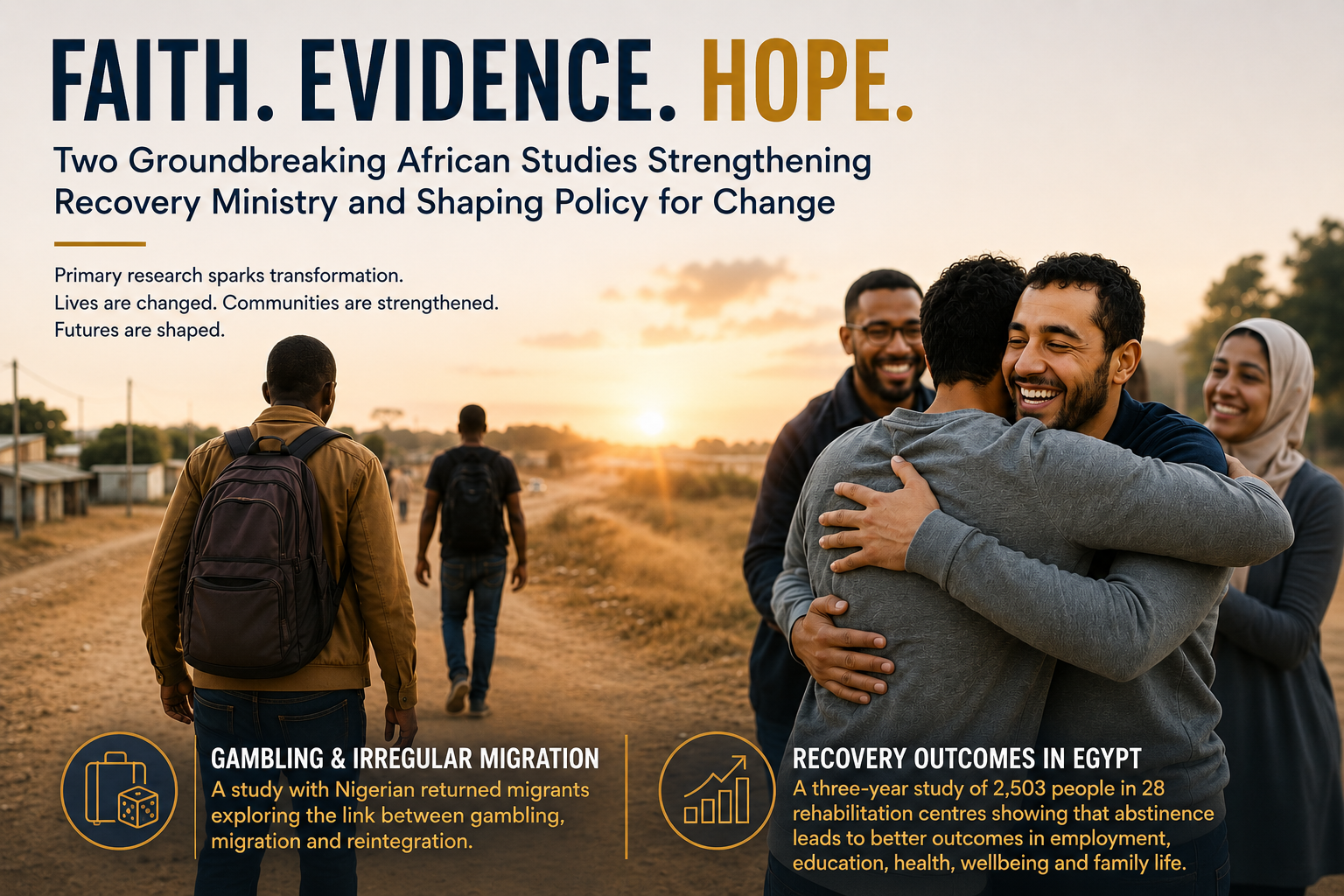
The first study, led by ISAAC Africa Lead Ikenna Molobe, explores the relationship between gambling and irregular migration among Nigerian returned migrants.
Building on years of research into migration, trauma and addiction, the study examines how gambling behaviours intersect with migration experiences and how these experiences affect people after returning home. Through interviews with returned migrants in Lagos and Edo States, the research seeks to understand “the nexus of Gambling in Irregular Migration” and to identify more effective reintegration and psychosocial support for those affected.
This is an important and often overlooked area of research.
Irregular migration is rarely driven by a single factor. Poverty, unemployment, conflict, exploitation, trauma and broken family relationships frequently intersect. Gambling can become part of that complex picture, whether as a coping mechanism, a false hope of financial escape, or an additional source of harm during migration and reintegration.
By listening directly to the experiences of returned migrants, Molobe’s research provides something that policymakers and practitioners desperately need: primary evidence from those living the reality rather than assumptions made from a distance.
The project is specifically designed so that its findings can inform recommendations for reintegration programmes and psychosocial support that reduce gambling-related harm among returned migrants.
Measuring Recovery Outcomes in Egypt
The second study comes from Dr. Ehab El Kharrat, one of ISAAC’s founding members and Director of the Freedom Programme in Egypt.
Published in the Journal of Substance Use and Addiction Treatment—one of the world’s leading journals in the addiction field—this represents the first large-scale prospective rehabilitation outcome study from Egypt and the wider Arab region.
The study followed 2,503 people admitted to 28 rehabilitation centres, successfully tracking 82% of participants over a three-year period.
Its headline findings are both encouraging and realistic.
The researchers report that 51% of participants were abstinent after three years, while abstinence was “clearly associated with positive outcomes like employment, education, better health, improved well-being, and stronger family relationships.”
Importantly, the study does not present recovery as simplistic or linear.
While the majority of abstinent participants experienced significant improvements across multiple areas of life, the researchers also observed that around 10% reported deterioration in some outcomes, highlighting the complexity of recovery and the continuing need for post-discharge support. Likewise, some non-abstinent participants still experienced improvements in family relationships and health, suggesting that residential rehabilitation may produce meaningful harm-reduction benefits even where complete abstinence has not yet been achieved.
Rather than overselling success, the research honestly reflects the realities of long-term recovery while providing robust evidence that effective rehabilitation changes lives.
Why Primary Research Matters
Both studies highlight something that is becoming increasingly important across healthcare, social care and public policy.
We rightly talk about evidence-based practice.
As Christian organisations, we should always seek to use interventions that have been shown to be effective.
However, evidence-based practice alone is only part of the picture.
Primary research asks an equally important question:
Does this approach still work within this particular culture, community and context?
Recovery is never one-size-fits-all.
Approaches developed in Europe or North America cannot simply be transplanted into Nigeria, Egypt or elsewhere without understanding the cultural, economic, spiritual and social realities people face.
Context matters.
Good research demonstrates not only that evidence-based practice exists, but that it continues to produce meaningful outcomes when applied within local communities by local practitioners.
That is exactly what these studies contribute.
Research That Shapes Policy
This matters because governments, international organisations and funding bodies increasingly expect evidence before investing in services.
Stories remain powerful.
Every transformed life tells a story of hope.
Every restored family reminds us why recovery ministry exists.
Yet stories alone rarely change policy.
Research does.
Primary evidence enables governments to develop more informed policy frameworks. It helps commissioners identify interventions that genuinely work. It strengthens funding applications by demonstrating measurable outcomes. Most importantly, it helps ensure that vulnerable communities receive services shaped by evidence rather than assumptions.
Academic credibility allows practitioners to contribute to conversations that shape national responses to addiction, gambling harm and social recovery.
For organisations working in countries with limited resources—or in places where openly Christian ministry may face significant challenges—this becomes even more valuable.
Evidence creates opportunities for dialogue.
Research opens doors.
Faithful Ministry and Academic Excellence
Perhaps the most encouraging aspect of both studies is that they remind us these two worlds do not need to compete. Compassion and evidence belong together.
Christian ministry has always cared deeply about both truth and transformation.
We serve because every person is made in the image of God.
We research because every person has value and the most effective support possible honors God.
When rigorous research grows out of decades of faithful ministry, everyone benefits: individuals, families, communities, governments and future generations.
We warmly congratulate Ikenna Molobe and Dr. Ehab El Kharrat on these outstanding achievements.
Their work reminds us that recovery ministry is about far more than responding to today’s needs. It is about helping shape tomorrow’s policies, strengthening future services and ensuring that hope reaches more people across Africa and beyond.
At ISAAC, we are proud that our members are not only serving faithfully on the front lines of addiction recovery but are also contributing to the global evidence base that will influence recovery practice for years to come—even while ministering in contexts where the gospel can be costly to proclaim.
That is something worth celebrating.
- Arizona State University – Gambling and Migration: Research and Community Outreach in Nigeria
- University of Bristol Hub for Gambling Harms Research – Exploring the Nexus of Gambling in Irregular Migration: A Study of Nigerian Returned Migrants
- Journal of Substance Use and Addiction Treatment – Impact of Abstinence on Employment, Education, and Health Outcomes in Egyptian SUD Rehabilitation Clients: A Three-Year Prospective Study